


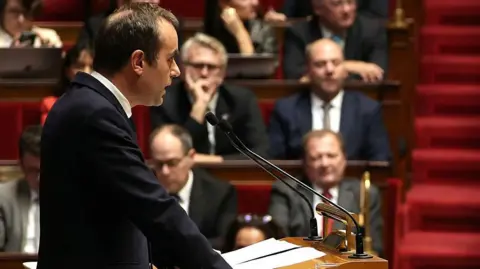
France's PM the government leader has informed the National Assembly that he supports suspending controversial retirement age changes implemented in 2023, preceding critical votes of no-confidence in the coming days.
The reforms, which raised the retirement age from 62 to 64, were considered key reforms in the French president's presidency.
"During autumn I will propose to lawmakers that we freeze the 2023 pension reform until the next presidential vote," Lecornu said to approval from left-wing parties.
The Prime Minister was returned to office recently only four days after he left office, and requires the support of Socialist MPs in the assembly if his cabinet is to remain in power.
Political Pressure
Opposition parties on the far right and left-wing have demanded no-confidence motions on Lecornu's government, for this Thursday and are calling for legislative votes.
The Socialist party announced they would be prepared to back the administration, but only if it promises a full suspension of Macron's pension changes.
"Unless he explicitly say the words 'immediate and complete freeze of the retirement changes', it will be a vote of no-confidence," Socialist MP Laurent Baumel previously stated on television.
"His fate lies in his destiny in his own hands. He realizes what he has to do if he wants to avoid being the prime minister who leaves office every week."
Reform Background
The changes were finally pushed through lawmakers in last year, fewer than a year after Macron was elected for a re-election.
There had been a lengthy time of political debate, labor protests and street protests, and in the end the bill had to go through without a formal consent in the assembly using a constitutional mechanism known as article 49.3.
Last week, the Prime Minister said it was something many citizens viewed as a "wound on democracy" .
Budgetary Impact
On recently he clearly stated to representatives that suspending the pension reform would amount to 400 million euros in 2026 and a extra 1.8 billion euros in the following year. This will have to be "compensated by other reductions," the Prime Minister stated.
Lecornu is France's third government leader in the recent period but even if he manages to stay he needs to get a financial plan through parliament that brings down a budget deficit projected at 5.4% of economic output this year.
France's public debt in recent months amounted to 3.4 trillion euros, or almost 114% of gross domestic product, the third largest in the euro area after the Greek economy and the Italian nation.
Government Calculations
The Prime Minister has been one of the president's most loyal allies, so his decision to reverse course on such a divisive measure demonstrates how keen the head of state is to prevent additional instability.
A Nobel laureate, who was shared the Nobel Prize in Economics on Monday, said earlier that he endorsed a halt of the pension reform, because it would still involve a smaller cost than the government collapse that would result from another government collapse.


